

Rubber Paint now has a stand of its own
Our elastic coating is in noticeably more DIY stores this summer, and it stopped arriving as a quiet row of buckets. It now comes with a full display stand carrying real coated samples on real materials. That piece of printed board has turned out to matter almost as much as the paint in it.
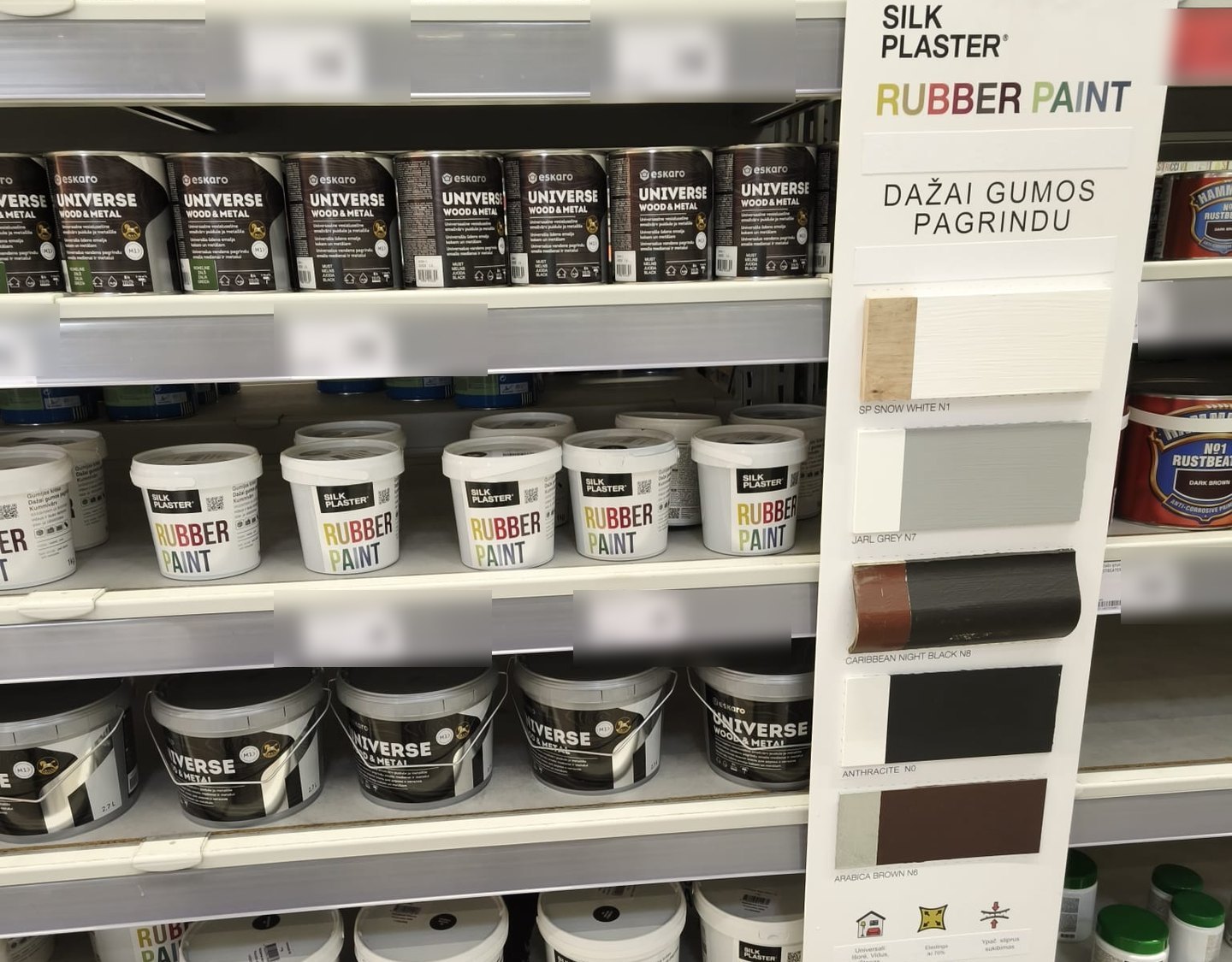
What actually changed on the shelf
Rubber Paint has been sold through retail partners in the Baltics for a while. Through this summer the number of stores carrying it went up sharply, and so did the amount of shelf we get in each of them.
The old setup was a row of buckets and a printed shelf label. It worked, in the sense that people who already knew what rubber paint is could find it. Everybody else walked past. Paint aisles are crowded and a white bucket does not explain itself.
So we built the stand. It is close to two metres of vertical board, mounted at the end of the shelf run where people slow down anyway, and it does one job: it shows the finish before anyone has to buy it.
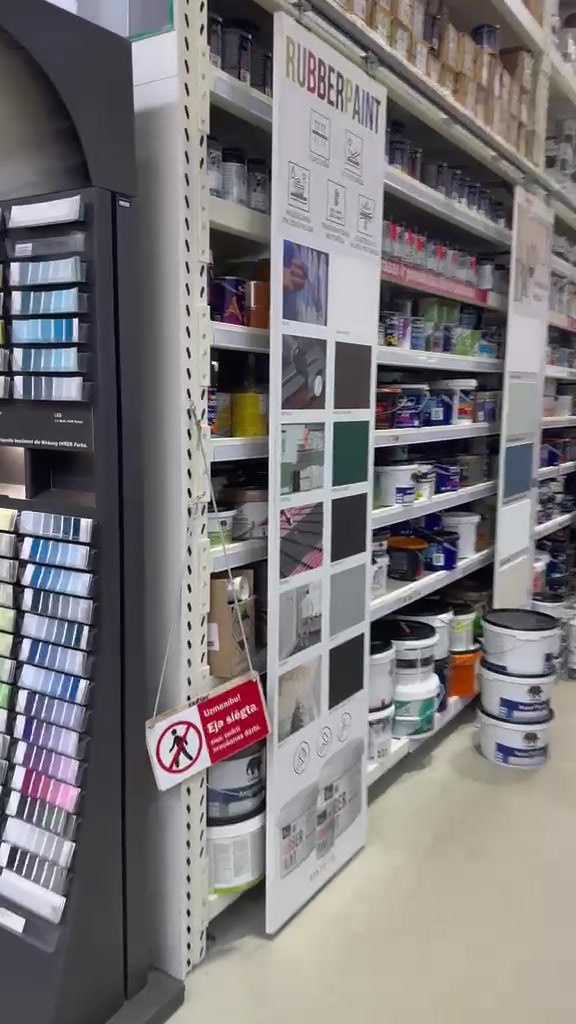
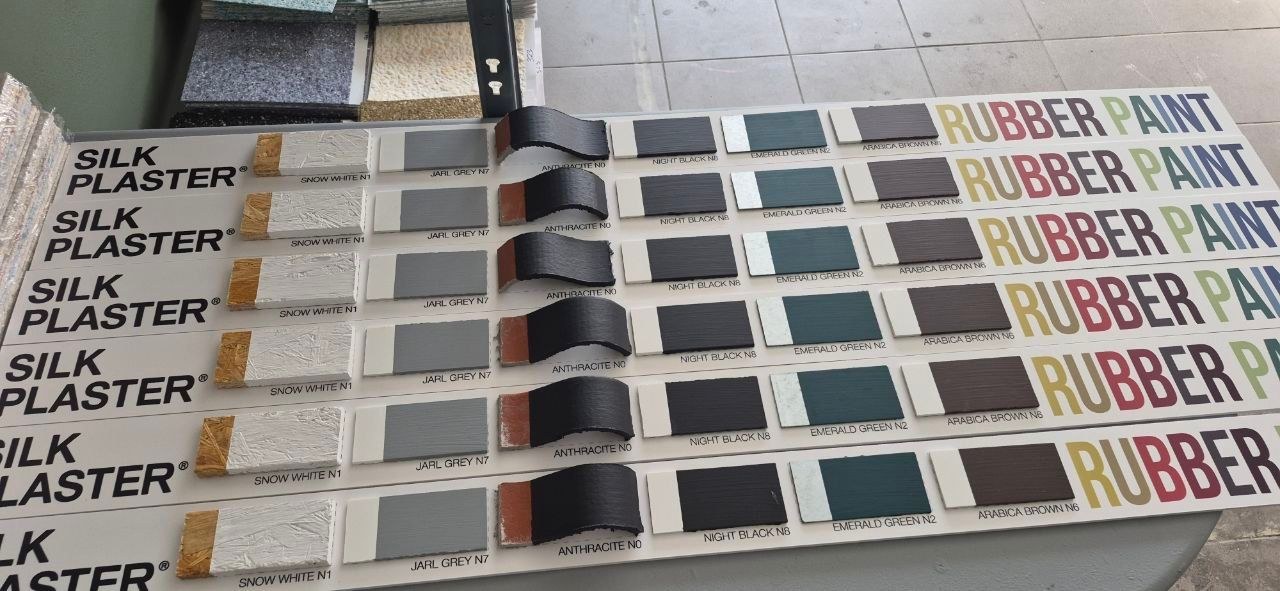
Real samples, on the materials people are painting
The swatches are not colour chips. Snow White N1 is painted on a piece of raw timber, so you can see how the film sits on grain. Caribbean Night Black N8 runs over a profiled roofing strip with a rusted edge showing at the top, which is exactly the surface most of our customers are trying to save. Jarl Grey N7, Anthracite N0, Arabica Brown N6 and Emerald Green N2 fill the rest of the board.
Underneath there are three pictograms and nothing else: use it inside, outside and on roofs, elasticity from 70 percent, very strong adhesion. Three claims is all a stand can carry. Anything more and people stop reading.
We learned this the expensive way on an earlier retail launch in Western Europe. Store teams told us plainly that customers hesitated at the packaging and committed after touching a physical sample. It was not a close call in the data either. Almost nothing sold off the box alone.
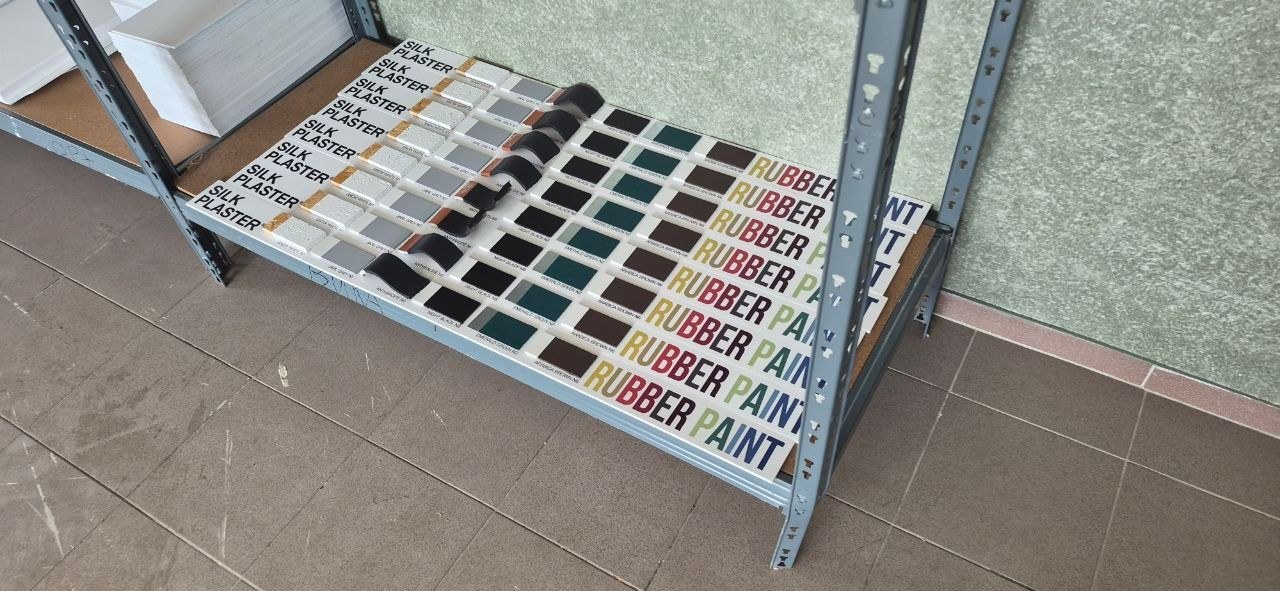
Local from the front of the pack
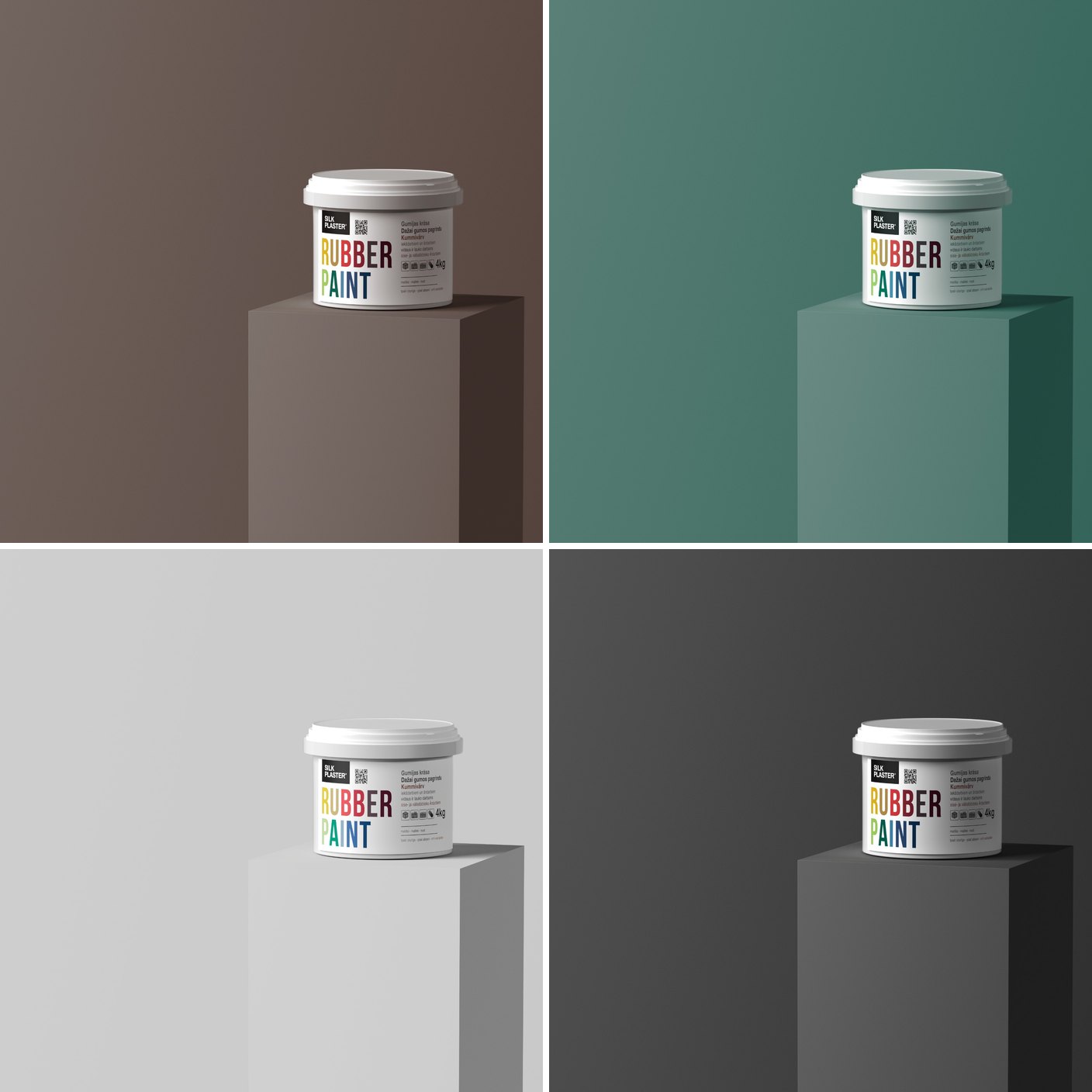
The buckets on those shelves are not export packs with a sticker on them. The product name reads in the local language on the front, with the full description on the back in Latvian, Lithuanian and Estonian. Small thing, but it removes the moment where a shopper turns a pack over looking for words they recognise.
Three sizes cover most of what people come in for: 1 kg for a door or a bit of trim, 4 kg for a fence or a balcony, 12 kg for a roof or a facade.
TikTok is doing most of the talking
This is not a product you can argue somebody into. You show it.
A rusted metal door before and after. A dried film stretched between two fingers until it looks unreasonable. Water beading on a fence that was grey and splitting a week earlier. Those clips do in nine seconds what a technical data sheet cannot do in two pages, and they are the reason people are now walking into stores already knowing the name.
Our Baltic account posts them at @silkplasterbaltic, mostly in Latvian and Russian, under #gumijaskrasa. If you sell this category, that feed is free content. Partners are welcome to reuse any of it.
The stand itself became a video too, which we did not plan. Here it is.
See it applied
Four surfaces, four short videos, no narration needed.
- Roofs, slate and ceramic tilesApplied in real weather, on the surface that ages worst.
- Facades, mineral walls and brickFrom surface repair through to the finished coat.
- Wooden doorsStart to finish on an old exterior door.
- Rusted metal doorsBefore and after, including the anti-corrosion primer step that metal always needs first.
- The retail standWhat the display looks like in a store.
- Interior and exterior overviewThe short version of the whole argument.
The written step by step for all four surfaces is here: How to apply Rubber Paint. Everything else lives on our YouTube channel.
What the paint actually is
| Type | Water-borne elastomeric coating, ready to use |
|---|---|
| Elasticity | Stretches from 70 percent, so it bridges hairline movement instead of splitting over it |
| Service temperature | Minus 60 °C to plus 90 °C |
| Consumption | 200 to 400 g/m² over two to three coats, depending on how absorbent the surface is |
| Finish | Matt, water repellent, EN 13300 Class 1 wet-scrub resistance |
| Emissions | A+ indoor air emission class |
| Surfaces | Roofs and roof tiles, facades, masonry and brick, concrete, foundations and balconies, wood and fences, metal over an anti-corrosion primer, plastics, pipework |
| Colours | Ten ready-to-use colours, plus RAL-based tinting from the Snow White base |
| Made in | Riga, Latvia |
Where this goes next
More stands are going up through the autumn as stores work through their own merchandising schedules, and the same display is being adapted for a chain in Bulgaria where the listing is in progress. The 12 kg pail is the format we expect to grow fastest, because once somebody trusts the product on a door they come back for the roof.
If you sell paint, this is an easy category to add.
It reaches a different buyer than decorative finishes, roofers, facade crews, property managers and people maintaining their own houses, while shipping on the same pallets through the same warehouse. We supply the stand, the samples and the social content with it.
Tell us what surface you would test it on and we will send a set.
SILK PLASTER GROUP SIA, Spilves 6B, Riga, Latvia. Photographs taken in partner stores and at our Riga facility, summer 2026.


