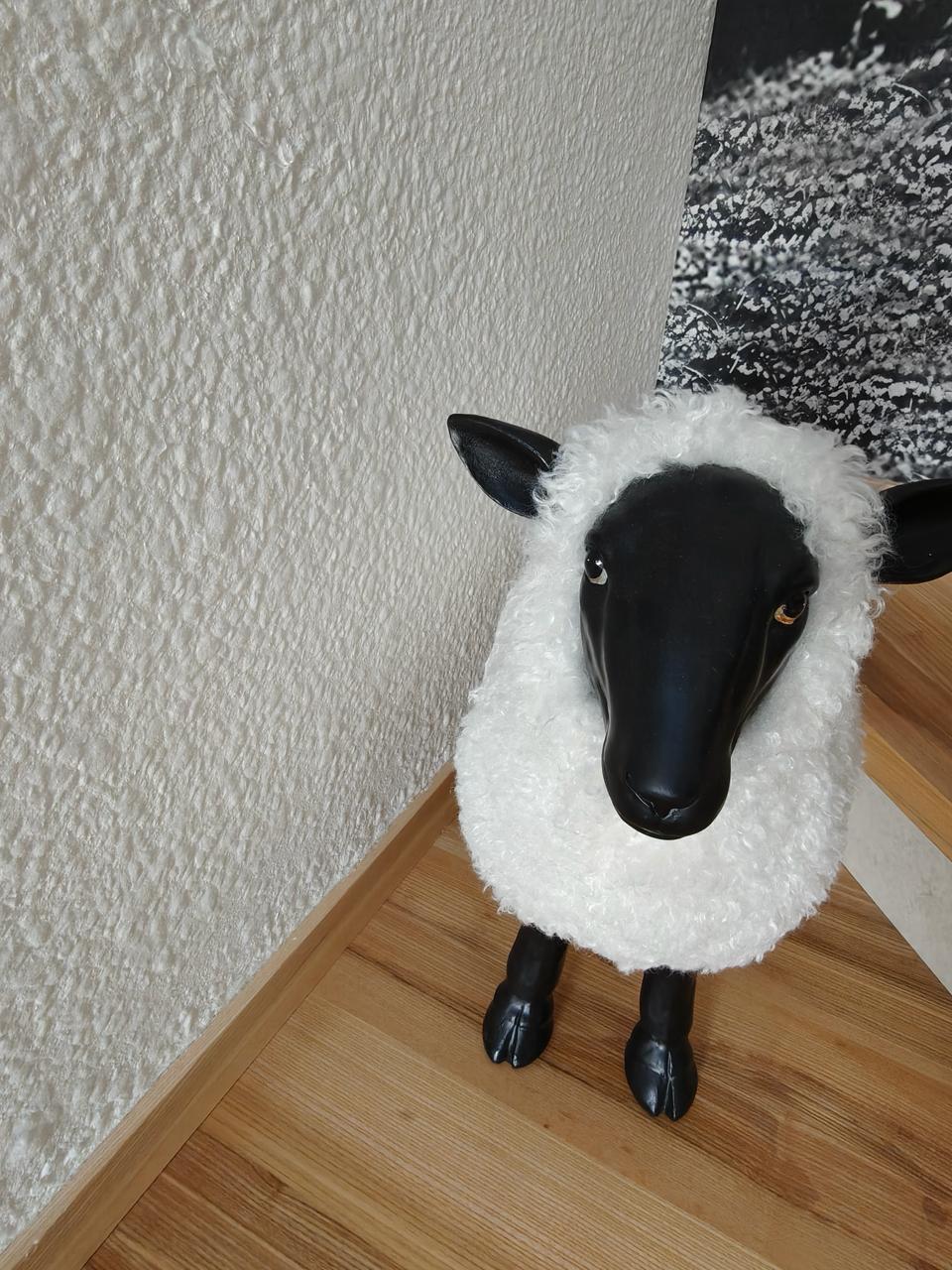
Our customer in the Polish Tatras wanted the downstairs hallway and stairwell of their new timber-framed house to feel like part of the landscape outside. The family had spent months picking finishes that would match the wooden stairs, the hand-carved sheep figure on the landing, and the black and white photo mural of Tatra shepherds they planned to install up the wall. Paint felt flat. Standard vinyl wallpaper felt wrong against raw pine beams. They chose Victoria 701, a white-cream textile wallpaper that goes on as a wet mix and dries into a soft, seamless coat. This is how the job went, and why the product suits a chalet-style mountain house.
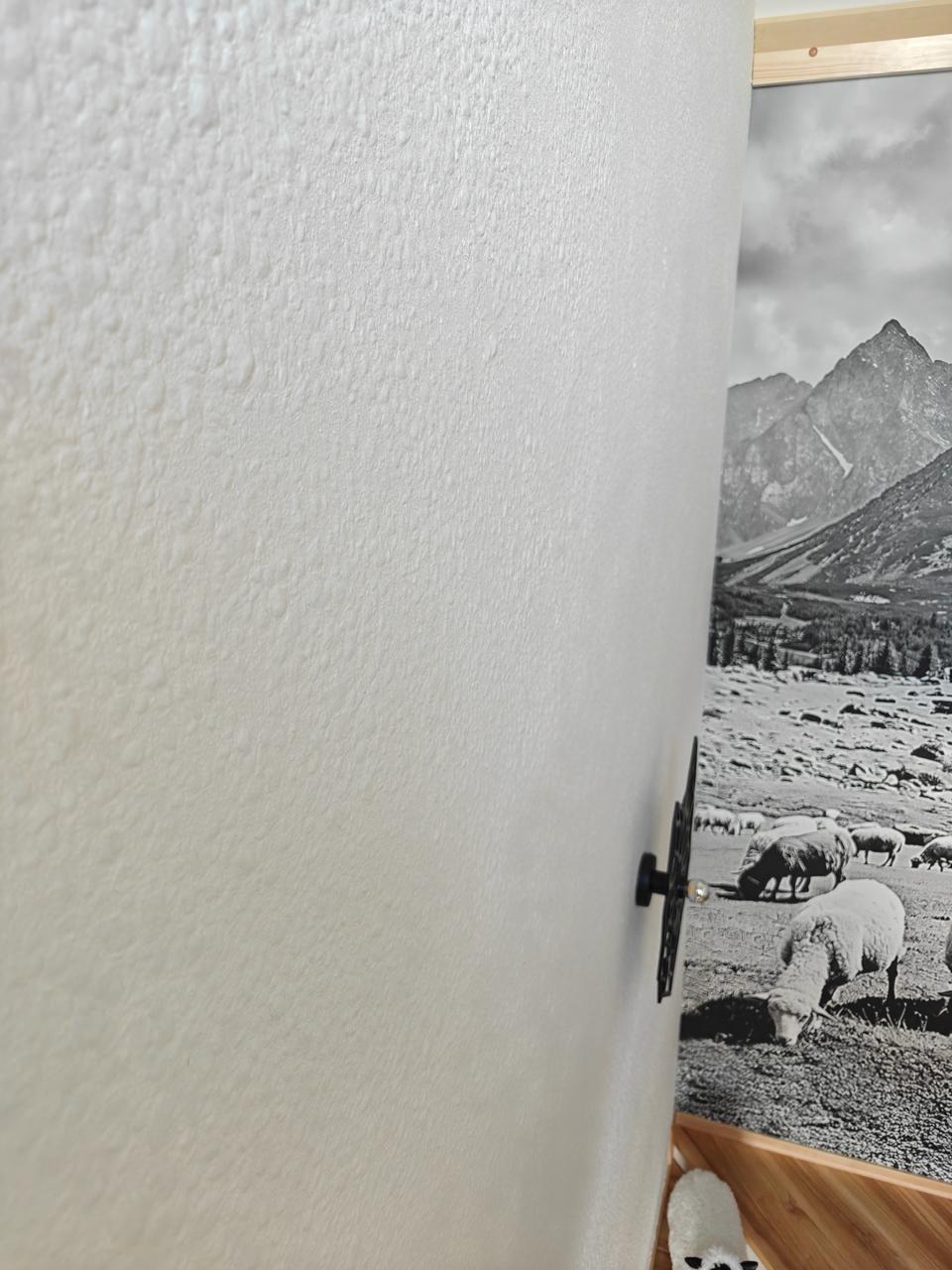
Victoria 701 silk plaster next to the Tatra mural in the stairwell.
Why silk plaster works in a mountain house
Mountain houses breathe differently. Temperatures swing, humidity moves with the weather, and wood shifts through the seasons. A wall finish has to move with the house, not fight it. Silk plaster is a liquid wallpaper made from cellulose and textile fibres with a plant-based binder. In Poland the material is usually sold as tynk bawełniany (cotton plaster) or tynk japoński (Japanese plaster). It arrives dry in a bag. You mix it with warm water, leave it to rest overnight, then trowel it onto the wall.
There are no seams. No overlapping strips, no pattern to line up, no corners where paper peels after a winter. On the stairwell in the photos, the finish runs unbroken from skirting to ceiling. Because it is a fibre-based coat rather than a film, the wall can still exchange moisture with the air. Hallways and mudrooms in mountain homes often have condensation problems, and a textile wallpaper tolerates this far better than vinyl.
Victoria 701: what it is and why we chose it
Victoria is one of the white and cream ranges in our catalogue. The 701 reference is a warm chalky white with very fine silk fibres that catch the light at an angle and flatten out when you look at it head-on. In a room with strong architectural features, this is what you want. The wall is the backdrop, not the subject. Next to dark timber stairs and a black iron wolf-shaped sconce, Victoria 701 reads as linen rather than paint. You can see the texture in the photo above: the wall to the left of the mural has a gentle stipple that softens the corridor.
The customer ordered by SKU. If you want the same finish in your own project, the product page is here: Victoria 701 - silk plaster. Each bag covers roughly four to five square metres at the recommended trowel thickness, and a stairwell of this size took three bags.
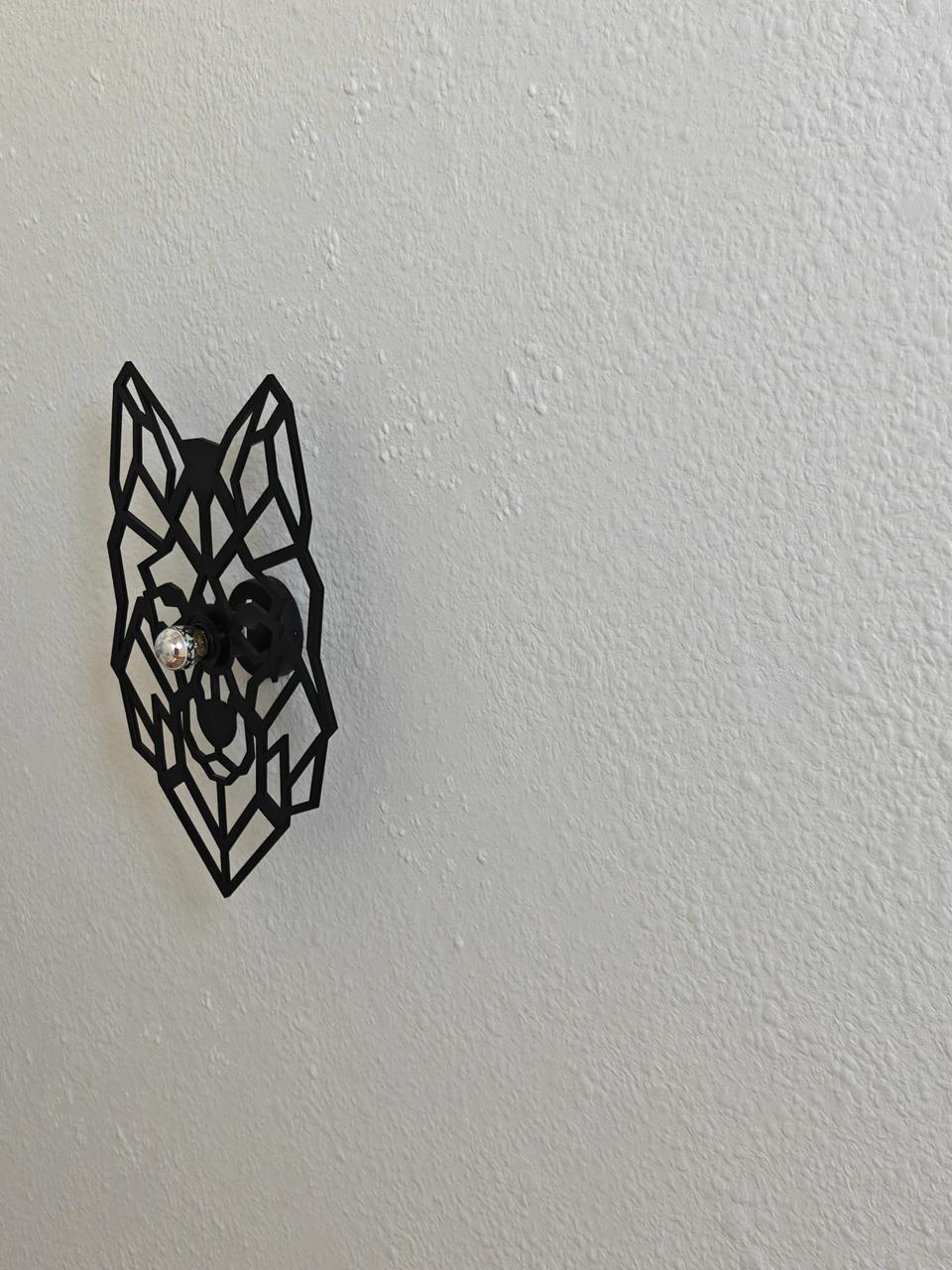
Geometric wolf sconce against Victoria 701. The cotton-fibre texture is visible at close range.
Tynk bawełniany and tynk japoński explained
Polish buyers often search for this material under two different names. Tynk bawełniany translates literally as cotton plaster, which describes the fibre content. Tynk japoński, or Japanese plaster, is the older trade name and comes from the application method. The trowel-on technique was popularised in Japan during the late twentieth century and spread across Eastern Europe from there. Both names point to the same product family. Silk plaster, textile wallpaper, liquid wallpaper, tynk bawełniany and tynk japoński all describe the cellulose and textile decorative coating our factory has been making since 1997.
If you are sourcing for a home in Zakopane, Podhale, Nowy Targ or elsewhere in the Tatras, look for any of these terms on local distributor listings. The specification sheet is identical.
How the work went
The owner did the preparation personally. New plasterboard, two coats of white primer, then the boards were left to dry for a full weekend. They mixed a single bag at a time with five litres of warm water, hand-kneaded the fibres for ten minutes, and rested the mix in a covered bucket for twelve hours. Application took one person around three hours per wall, working wet-on-wet so the joins disappeared.
Because the material stays workable for several hours after trowelling, small errors are easy to correct. If a corner looks thin, you wet the surface, add a little more mix, and feather it back in. There is no repainting, no tearing off old paper, no filling of nail holes with compound that never quite matches. For a house still being decorated room by room, that repairability matters. Drying took thirty-six hours in the heated stairwell at 19 °C. The family moved the ceramic sheep and hung the Tatra mural the next morning.
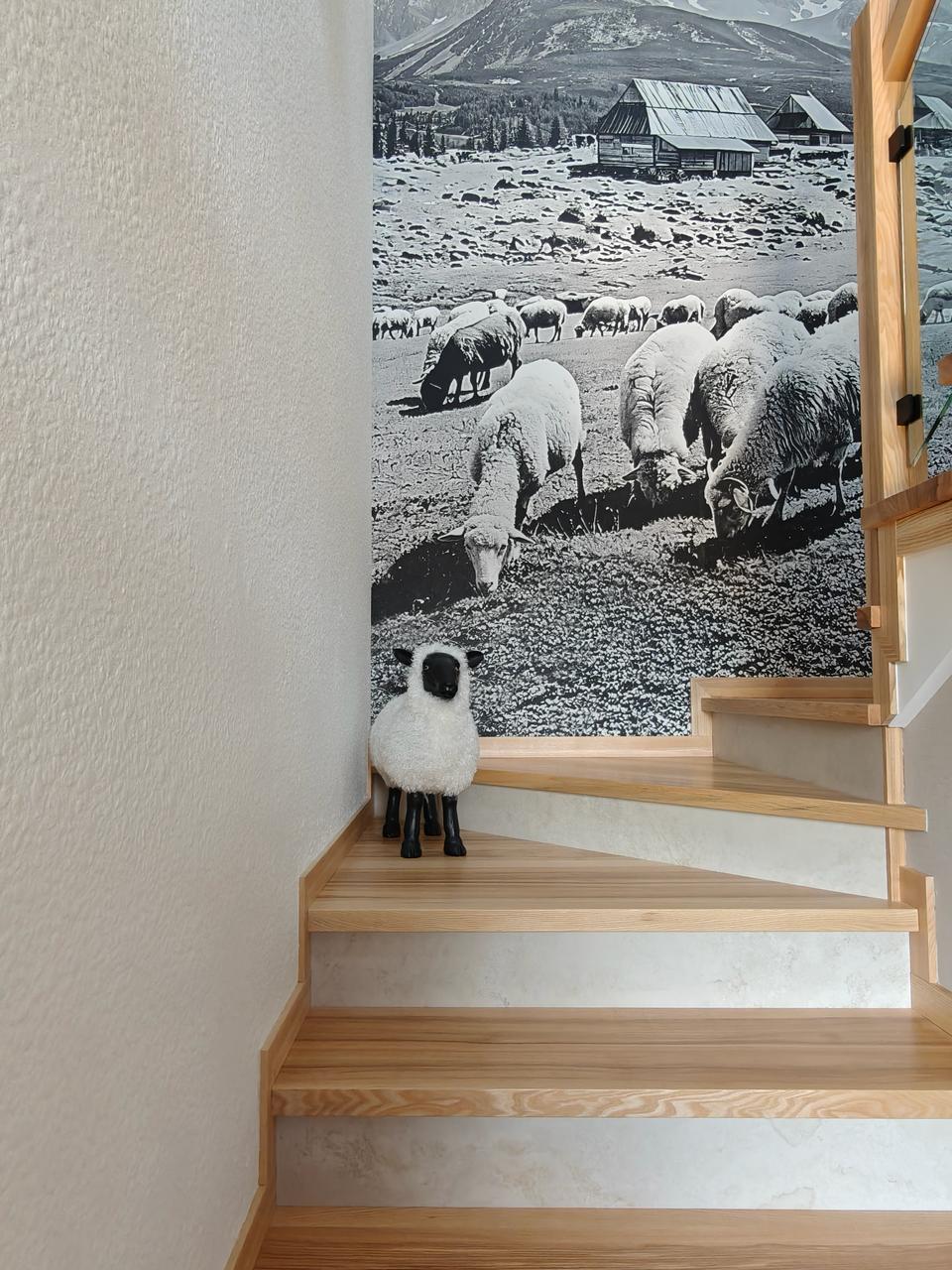
The finished stairwell. Victoria 701 on the side walls, sheep mural on the feature wall.
Eco credentials that matter in a mountain build
Anyone building in a protected mountain region knows the paperwork around emissions and materials can be strict. Victoria 701 is water-based and VOC-free, and it carries hypoallergenic certification. There is no formaldehyde in the binder. You can sleep in the room the same night the wall is finished. For a family with small children, or for a rental cottage taking guests at short notice, that matters on the ground, not only on paper.
The cellulose fibres come from recycled paper. The silk content is a textile by-product. The mineral additives are inert. When the wall is eventually removed, the material is not classified as hazardous waste in EU regulations, which simplifies renovation years later.
The finished look
The ceramic sheep watches visitors from the landing.
The photos do most of the talking. The stairwell mural of grazing sheep in the Tatra high pastures gives the house its identity. The Victoria 701 walls on either side are quiet. They hold the light from the bulb lamp without bouncing it harshly, and the warm white sits well against the honey-coloured pine treads. The ceramic sheep on the landing fits the mood the family wanted: a working mountain house rather than a showroom.
The geometric wolf silhouette in black steel and the bare bulb above it finish the room. None of this would have worked against a loud wall colour. Silk plaster earns its keep here because it steps back and lets the rest of the house speak.
To provide the best experiences, we use technologies like cookies to store and/or access device information. Consenting to these technologies will allow us to process data such as browsing behavior or unique IDs on this site. Not consenting or withdrawing consent, may adversely affect certain features and functions.
Functional
Always active
The technical storage or access is strictly necessary for the legitimate purpose of enabling the use of a specific service explicitly requested by the subscriber or user, or for the sole purpose of carrying out the transmission of a communication over an electronic communications network.
Preferences
The technical storage or access is necessary for the legitimate purpose of storing preferences that are not requested by the subscriber or user.
Statistics
The technical storage or access that is used exclusively for statistical purposes.The technical storage or access that is used exclusively for anonymous statistical purposes. Without a subpoena, voluntary compliance on the part of your Internet Service Provider, or additional records from a third party, information stored or retrieved for this purpose alone cannot usually be used to identify you.
Marketing
The technical storage or access is required to create user profiles to send advertising, or to track the user on a website or across several websites for similar marketing purposes.